New Product Announcement: Security Cleaner and Disinfectant

August 19th, 2020 by Ima Admin

Kills The Virus That Causes Covid-19

This product is on EPA List N: Disinfectants for Use Against SARS-CoV-2 (the virus that causes COVID-19)


All-Purpose Disinfectant Cleaner And Degreaser

Antibacterial, Antimicrobial, Multi-Surface, Surface, Triple Action, Bathroom, Floor, Glass & Surface, Kitchen, Restroom, Cleaner, and Disinfectant. Fungicide, Bactericide, Virucide.


Kills And Cleans With The Power Of Hydrogen Peroxide

Powerful 2.4% hydrogen peroxide powers-away soils and acts as the active ingredient in this disinfectant.


Stop The Spread… Wherever It May Be

This one-step, virucidal, bactericidal, fungicidal, cleaner, and degreaser disinfects and deodorizes kitchen, restroom, and other public facility surfaces.


Features and Benefits:

  • All-purpose disinfectant cleaner
  • No mixing required, ready-to-use product
  • Excellent degreaser
  • Safe for use on most surfaces
  • One-step viricidal, bactericidal, and fungicidal product
  • Effortlessly deodorizes tough areas with the power of peroxide
  • Removes mold and mildew stains
  • Kills SARS-CoV-2 (the virus that causes COVID-19) and other viruses
  • Kills 99.9% of germs such as Salmonella, Staph, E. coli, and Listeria
  • On EPA List N… Kills SARS-CoV-2
  • EPA-Registered
  • Kills 99.9% of germs
  • 3 in 1 all-purpose cleaner

Find more information on the product webpage: Security Cleaner and Disinfectant.


EPA Reg #: 85837-4-5174       Active Ingredient: 2.40% Hydrogen Peroxide


EPA List N Disinfectants

August 13th, 2020 by Ima Admin

EPA List N: Disinfectants for Use Against SARS-CoV-2

SARS-CoV-2 is the Coronavirus that causes COVID-19.  See this post for more information on the virus and how to mitigate the spread.

We regularly see or hear from people who are using unregistered products to clean surfaces and protect themselves and their employees from COVID-19.  The unregistered products used range from hand sanitizers to chemicals without appropriate claims to products with misleading information.

Both QDII Sanitizer (QDII) and One Step Quaternary Cleaner and Disinfectant (One Step) are included in EPA’s List N under the primary registrant’s labels.  These products are therefore approved by the EPA for use against SARS-CoV-2, the virus that causes COVID-19.

Security Cleaner and Disinfectant (DeVere’s newest sanitizer) is also included on EPA’s List N and an effective way to kill SARS-CoV-2 while cleaning and degreasing.

The EPA registration for our One Step label is 10324-154-5174.  The first set of numbers denotes the primary registrant (Mason Chemical Company in this case).  The second set of numbers indicates the number of their registration.  The final set of numbers indicates the final manufacturer (DeVere in this case).

The EPA registration for our QDII Sanitizer label is 10324-117-5174.  Security Cleaner and Disinfectant’s EPA registration number is 85837-4-5174.  The first set of numbers denotes the primary registrant (Mason Chemical Company in this case).  The second set of numbers indicates the number of their registration.  The final set of numbers indicates the final manufacturer (DeVere in this case).

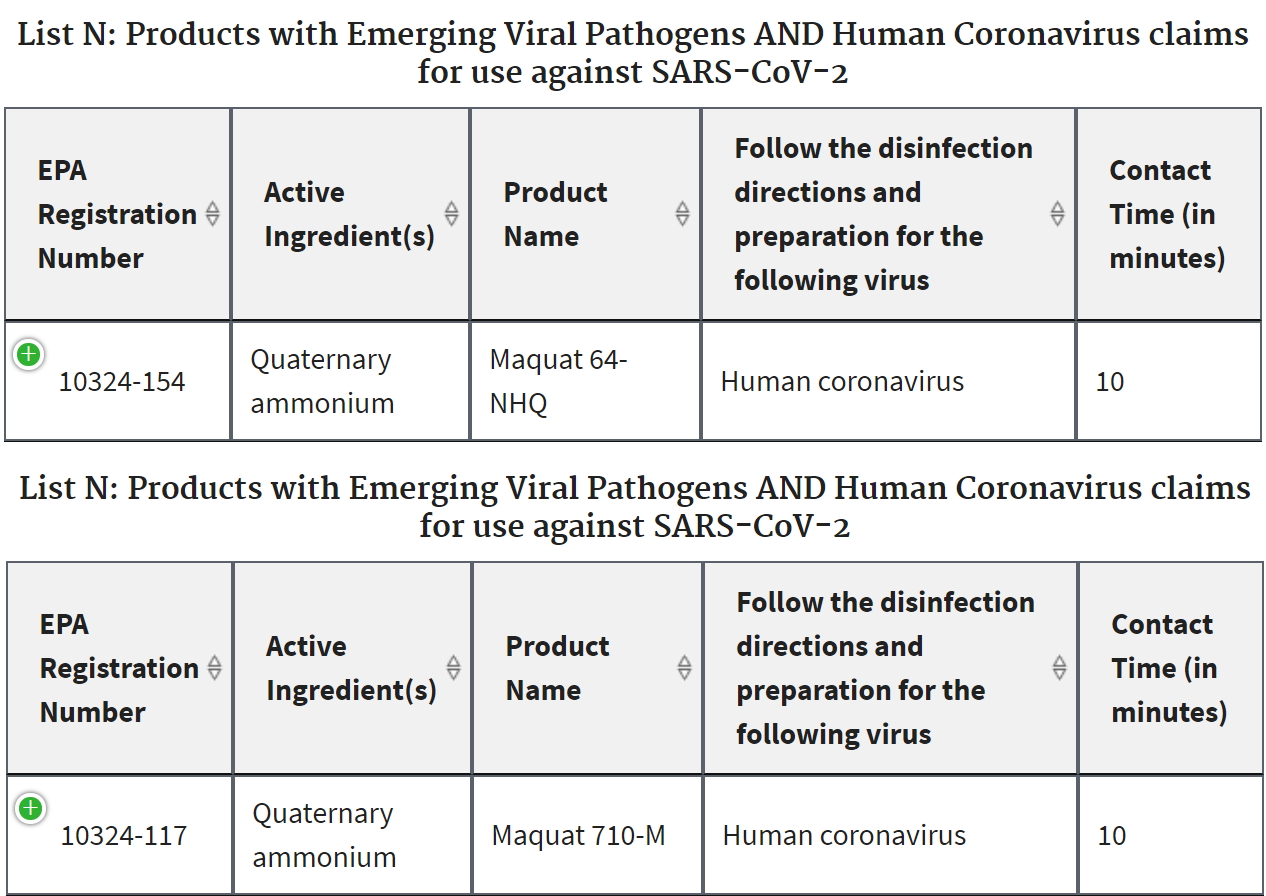
Here is a list of the current EPA List N: https://www.epa.gov/pesticide-registration/.  You can put 10324-154 or 10324-117 in the search field to find the base label.  Note that this label is not marketed as a product without the final manufacturer code.  The product pulls all claims and efficacy statements from the base label.

Here are the results you see when you enter these codes into the EPA’s searchable list:
DeVere EPA List N

Both QDII and One Step have instructions on the label to kill Human Coronavirus.  These same use directions are now applicable to the emerging version of the Human Coronavirus.  The effective use dilution for QDII is 3oz per 5gal of water.  The effective use dilution for One Step is 2oz per 1gal of water.


Total Cost of Sanitation

August 4th, 2020 by Ima Admin

Reducing the Total Cost of Sanitation

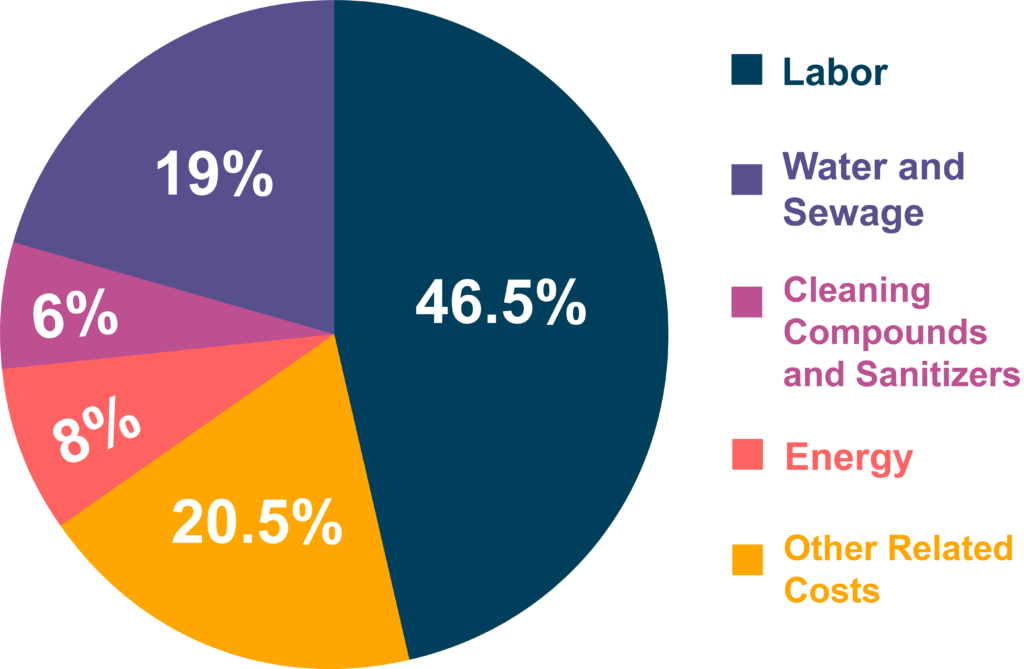
Not all chemical sanitation suppliers can work with you to drive down sanitation program expenditures. Some representatives are not trained on the costs of energy, labor, water, and wastewater. Chemicals make up only around six percent of your total sanitation cost. DeVere sanitation experts consider the costs of sanitation beyond that of just the chemical.


Cost Breakdown of Sanitation

The total cost of sanitation varies and generally involves the following expenditures:

In addition to identifying the proper selection and use of chemicals, we help optimize sanitation procedures and critical plant systems. When auditing critical plant systems, we look for deficiencies in steam, compressed air, refrigeration, processing, wastewater, and water systems. Many of these systems have a direct impact on product quality, production cleanliness, and costs at your facility. For instance, sanitation employees using poor procedures often leads to excessive costs in wastewater treatment. In food plants, teaching dry pickup and low-pressure rinsing techniques prior to any foam or boosted pressure rinsing saves money and improves results. Too many sanitation workers think that if they have a hose in their hand they are doing work. Poorly designed or programmed CIP systems can burn through cash.


Costs of Sanitation Program Inefficiencies

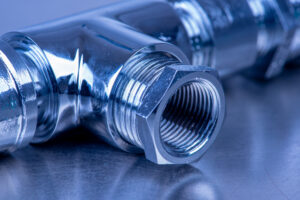
There are many more small sanitation errors that can add up to big costs. To illustrate, steam lost from a 1/32-inch leak, sometimes seen in a crack of a threaded joint, can cost $300 dollars per year. Furthermore, compressed air is the most expensive utility used for tools and equipment due to 81% of the energy used to make it lost in heat.  Do you ever hear air leaking when you are in your plant? A single ¼-inch hole in a compressed air system can cost over $8000.00 per year.


Sanitation Program Audit

When we help you conserve water, steam, and utilities we can reduce your expenses beyond just the cost of the chemical. If you want a partner that can help you reduce your total sanitation cost, contact us at DeVere Chemical for a complete optimization audit.

Contact us for a virtual or in-person, no-charge facility audit.  Ryan Dunn and the rest of our sanitation support team are ready to help.


Hand vs. Surface Sanitizers

July 29th, 2020 by Ima Admin

The Difference Between Hand and Surface Sanitizers

For skimmers:

  • The FDA regulates sanitizers that are effective on human skin and anything else that is alive.
  • The EPA regulates sanitizers intended for use on inanimate surfaces.

Bac-Off is an FDA-regulated product and a hand sanitizer with 0.13% benzalkonium chloride as the active ingredient.

Bac-San is an FDA-regulated product and a hand sanitizer with 70% ethyl alcohol as the active ingredient.

The FDA does not allow individual kill claims.  Here is a link that shows when the FDA enforced this rule against Purell: https://www.cnn.com/2020/01/27/business/fda-purell/index.html.

Both Bac-San and Bac-Off are hand sanitizers and equally effective in the eyes of the FDA.  Here are the text and link from the FDA:

At this time, three active ingredients—benzalkonium chloride, ethyl alcohol, and isopropyl alcohol—are being deferred from further rulemaking to allow for the ongoing study and submission of additional safety and effectiveness data necessary to make a determination regarding whether these active ingredients are generally recognized as safe and effective for use in OTC consumer antiseptic rub products. Their status will be addressed either after completion and analysis of the studies or at another time, if these studies are not completed. Currently, the FDA does not intend to take action to remove hand sanitizers containing these three active ingredients from the market.

https://www.fda.gov/news-events/press-announcements/fda-issues-final-rule-safety-and-effectiveness-consumer-hand-sanitizers


The CDC acknowledges that benzalkonium chloride hand sanitizers are eligible according to the FDA.  According to the CDC, “available evidence indicates benzalkonium chloride has less reliable activity against coronavirus than either of the alcohols”.  They cite one article that states concentrated ethanol-based hand sanitizers are more effective than benzalkonium chloride-based hand sanitizers.  Note that hand sanitizers with benzalkonium chloride still have efficacy and the CDC does not override the FDA.

https://www.cdc.gov/coronavirus/2019-ncov/infection-control/hcp-hand-hygiene-faq.html


EPA-registered products (e.g. QDII Sanitizer, QDII Food Service Sanitizer, Golden Sanitizer, Sanitizer Concentrate, Security Floor Sanitizer, and One Step Quaternary Cleaner and Disinfectant) can have kill claims against individual organisms.  The FDA does not allow for this type of claim.

Labels for all EPA-registered products are supposed to contain the following text: “It is a violation of Federal law to use this product in a manner inconsistent with its labeling.”  This type of product label will not contain direction for sanitizing skin or any other living tissue.  Therefore, technically it is illegal to use an EPA-registered product as a hand sanitizer.


Summary: In the eyes of the FDA, both Bac-Off and Bac-San are equally effective and legal.  The CDC recently provided guidelines stating that while products like Bac-Off are effective, products like Bac-San are more effective than those like Bac-Off.  We cannot make kill claims against individual viruses on these FDA-regulated products because the FDA does not allow for that type of claim.


Side notes:

The Alcohol and Tobacco Tax and Trade Bureau (TTB) regulates who can buy and sell ethyl alcohol.  This includes the ethyl alcohol used in hand sanitizer applications.  The TTB does not control any product claims.  They do limit who can buy which grades of ethyl alcohol and how much they can buy.  Note that The TTB has removed limits for the current purchasing season that ends June 30, 2020.

The United States Department of Transportation (DOT) regulates how hazardous materials (including many alcohol-based hand sanitizers) are packaged for transport and shipped within the United States.  The DOT has revised its regulations for alcohol-based hand sanitizers until July 2, 2020.  This revision allows companies to ship a variety of hand sanitizers with available packaging.


November 2020 Update:

After extending the enforcement direction on the shipping of alcohol-based hand sanitizers until October 31, 2020, the Pipelines and Hazardous Materials Safety Administration (PHMSA) division of the DOT let the enforcement standard revert back to the one that existed pre-pandemic.  This means that shipments of alcohol-based hand sanitizers above the limited quantity exception (1L for Bac-San) must be in UN-regulated packaging with DOT-compliant labeling.


Bar Cleaners and Support

July 8th, 2020 by Ima Admin

DeVere offers many products made to help with keeping a clean and sanitized bar. From surface cleaners to 3rd sink sanitizers, we have everything you need to keep any bar looking the best it can. Below is a full guide to our bar cleaners and sanitizers.

Surface Cleaners and Disinfectants

QDII Sanitizer and QDII Food Service Sanitizer (Ready-to-Use) – These products are disinfectants, sanitizers, deodorizers, mildew-stats, and virucides – all in one! They are great for disinfecting counters and are safe to use on food-contact surfaces. QDII Sanitizer also works as a 3rd sink sanitizer.

WOW All Purpose Cleaner – WOW is one of the strongest yet safest detergents made. This product is safe to use on a variety of hard surfaces and also cleans no-wax, hard floors. WOW cleans both light soils and heavy grease.

Dishwasher Products

Machine Dishwashing Liquid – This product works with our pumps and dishwashers offered in our dishwashing program (more information below). Machine Dishwashing Liquid will quickly remove all food soils and will leave all dishes, flatware, and glassware sparkling clean. This product is normally corrosive to soft metals, but you can use it with Anti-Corrosion Additive to become safe to use on aluminum and other soft metals.

Machine Dishwashing Powder – This product will remove all soils and stains from dishes, glassware, and flatware, leaving them sparkling clean. Machine Dishwashing Powder is available in capsules for automatic dispensing with our dispensers, or pails for manually putting the powder in the dishwasher.

Cleaners and Sanitizers for 3 Sink Setups

Dish Detergent – This product is a great detergent for the first sink and will penetrate the heaviest of soils after just 2-3 minutes of soaking. Dish Detergent also leaves no streaks and has a pleasant scent.

Heads Up 10 – This product is an EPA registered cleaner/disinfectant/sanitizer for use in areas where mineral soils are a challenge. Heads Up 10 is great for the 3rd sink in 3 sink setups and leaves behind a shiny, mineral free surface after sanitizing.

Dishwashers and Services

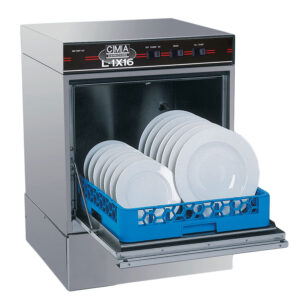
In addition to all of our amazing products, we also offer a personalized dishwashing program. Customers can choose to lease or purchase from a variety of ADS or CMA dishwashers and receive free installation, maintenance, and more! For more information, please see this flyer.

If you have any questions about any of our products or our dishwashing program, please contact us.


Industrial Dishwashing Systems

June 10th, 2020 by Ima Admin

DeVere offers a wide range of kitchen products that are sure to satisfy everyone’s dishwashing and kitchen cleaning needs, from homes to big restaurants. To learn more about our products, please visit our kitchen and deli category page. In addition to all of our amazing products, we also offer a personalized dishwashing program with a variety of industrial dishwashing systems. Customers can choose to lease or purchase from a variety of ADS or CMA dishwashers and receive free installation, maintenance, and more!

Lease

  • Choose from a variety of ADS or CMA dishwashers at competitive monthly lease rates
  • Receive FREE installation & periodic maintenance checks (based on rack usage)
  • Receive FREE emergency service for dishwasher malfunction

Purchase

  • Select a new or used ADS or CMA dishwasher and purchase it at a discounted price
  • Receive FREE delivery, installation & periodic maintenance checks (based on rack usage)
  • Receive DISCOUNTED emergency service rates for ADS or CMA dishwashers

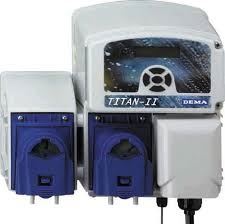
Titan II Dishwasher Pump Features

  • Modular design allows for easy conversion from a 2 to 3 product system
  • Splash resistant ABS material for durability
  • Stainless steel mounting plate for easy installation
  • Multilingual digital display in English, Spanish, French, and Portuguese
  • Digital programming for quick setup
  • Probeless alarms for liquid or dry products
  • Built-in rack counter

Dishwasher Products

  • Machine Dishwashing Liquid
    • Concentrated, low foaming detergent quickly removes soils & prevents re-disposition
    • Formulated for use in high & low temp dishwashers, glass & mug washers
    • Works in hard water; free-rinsing
  • Rinse Rite Low Suds
    • Rinse aid causes water to sheet completely off dinnerware & glasses
    • Formulated for use in high & low temp dishwashers
    • Reduces drying time; eliminates water spots
  • Sanitizer Concentrate
    • Commercial-strength EPA registered sanitizer
    • Formulated for use in low temp dishwashers
    • Has increased dinnerware de-staining power

If you have any questions about our industrial dishwashing systems or products, please see this flyer for more information or contact us.


Types of Disinfectants

May 11th, 2020 by Ima Admin

Bacteria, mold, mildew, and viruses are responsible for illnesses, bad odors, and ruined property. Disinfectants and sanitizers exist to help us mitigate these destructive actors. DeVere offers a wide range of disinfectants and sanitizers so that we have a solution to every cleaning problem. This informative post will outline how different types of disinfectants work and what their advantages and disadvantages are. All types of disinfectants have the same goal but have different ways of achieving it.

Alcohol

Alcohols are broad-spectrum antimicrobial agents that damage microorganisms by denaturing proteins, causing membrane damage and cell lysis.

Advantages: 70% ethyl alcohol with a 20-minute contact time proves to be a powerful germicide effective against many pathogens.
Disadvantages: 
Alcohol is inactivated by organic matter. It evaporates quickly, making many people prefer not to use it because it may require multiple applications. May cause damage to plastics.

Our Product: Bac-San
Note that Bac-San is an FDA-regulated hand sanitizer meant to sanitize hands not surfaces.

Sodium Hypochlorite (Chlorine Bleach), Sodium Dichloroisocyanurate (Organic Chlorine), and other Chlorine-donors

Chlorine compounds function through their electronegative nature to denature proteins and are considered broad-spectrum, being effective against bacteria, enveloped and non-enveloped viruses, mycobacteria, and fungi.

Advantages: Readily available and cost-effective. Effective and kills many microorganisms. A potent deodorizer.
Disadvantages: 
Irritates skin and eyes. Can discolor and damage metal surfaces. Inactivated by organic debris. Less effective in hard water. Has a limited shelf life of about 6 months under normal conditions. Will deteriorate with time and exposure to light. It does not work well on spore forms of bacteria or mycobacterium.

Our Product: Sanitizer Concentrate
Note that Chlor Foam, Chlor CIP, Lightning, and several other products contain chlorine bleach due to its cleaning ability.
Chlor Foam Powder and Chlor CIP Powder contain sodium dichloroisocyanurate and are not EPA registered.

Peroxygen Compounds (Peroxides)

Hydrogen peroxide, the superoxide ion radical, and the hydroxyl radical are intermediate products in the reduction of oxygen to water. The hydroxyl radical is said to be the strongest oxidant known, and it is by this mechanism that hydrogen peroxide is believed to do the actual killing of bacteria.

Advantages: Effective against a wide variety of organisms: bacteria, yeast, fungi, viruses, and spores. Anaerobes are even more sensitive because they do not produce catalase to break down the peroxide. In general, peroxides have greater activity against gram-negative than gram-positive bacteria. Unlike many disinfectants, peroxygen compounds are not affected by the addition of organic matter and salts.
Disadvantages: In liquid solutions, peroxygen compounds are constantly creating oxygen and typically have relatively shelf-lives while in solution. They also have no residual efficacy after being left in a solution on a surface.

Our Products: Security Floor® Sanitizer and Security Cleaner and Disinfectant
Note that Security Floor® Sanitizer theoretically lasts forever when it is used dry. We have stability studies for 10-years on this product with no loss in efficacy.

Chlorhexidine

Chlorhexidine is detrimental to microorganisms by reacting with the negatively charged groups on cell membranes which alters permeability.

Advantages: Effective against many fungi, yeast, bacteria, and some viruses. Very low toxicity to birds and humans.
Disadvantages:
Makes a poor cleaner and has decreased effectiveness in the presence of organic matter and hard water. It is not effective against several types of bacteria. Not effective against bacterial spores or mycobacterium. Will not kill hydrophilic viruses.

Tamed Iodine (Iodophors)

Iodophors are iodine complexes that have increased solubility and sustained release of iodine.  One of the more commonly used iodophors if povidone-iodine. They are good for general use and are less readily inactivated by organic matter than elemental iodine compounds. The dilution of iodophors actually increases the free iodine concentration and antimicrobial activity.

Advantages: Iodophores kill a wide range of disease-causing organisms including bacteria, fungi, many viruses, and most micro-organisms. Works well in cold, hot, and hard water. Readily available.
Disadvantages: Moderately expensive. Can stain tissues and some materials. Can cause drying and cracking of skin after prolonged use. May corrode metals with prolonged exposure. Inactivated by prolonged contact with organic matter. Does not affect hydrophilic viruses.

Our Product: Golden Sanitizer

Phenolics

Phenols are broad-spectrum disinfectants that function by denaturing proteins and inactivating membrane-bound enzymes to alter the cell wall permeability of microorganisms.

Advantages: Many products are readily available. Kills fungi, Tuberculosis, certain viruses, Staphylococcus, and Pseudomonas bacteria. Retains effectiveness in hard water. Does not stain surfaces or leave a residual odor. Cost-effective. 
Disadvantages:
High concentrations will burn skin, eyes, and lungs. Does not kill nonenveloped viruses, such as parvovirus, polyomavirus, papillomavirus, adenovirus, and reovirus, nor will they kill all bacteria types. Toxic to cats and possibly reptiles.

Pine Cleaner contains the phenolic pine oil and is not EPA-registered

Gluteraldehydes

Aldehydes are highly effective, broad-spectrum disinfectants, which typically achieve sterilization by denaturing proteins and disrupting nucleic acids.

Advantages: Effective against all pathogens. Equally effective in cold, hot, and hard water. Effective in the presence of organic debris. Skin irritation is minimal even at 2%. Rated by the Environmental Protection Agency (EPA) as the lowest tissue irritation level possible, non-toxic, and non-teratogenic. 
Disadvantages: 
May require a medical license for purchase. EPA testing limited on animal and bird pathogens. Inadequate ventilation may result in eye and respiratory irritation in humans and birds. Prolonged contact with concentrated form may cause skin peeling and discoloration.

Quaternary Ammonium Compounds (QACs or Quats)

These compounds are cationic detergents that are attracted to the negatively charged surfaces of microorganisms, where they irreversibly bind phospholipids in the cell membrane and denature proteins impairing permeability. DeVere manufactures a variety of QACs. Our team can answer detailed questions about use rates, activity, and QAC generations.

Advantages: An excellent general disinfectant. Kills both Gram-negative and positive bacteria, many viruses, and chlamydia. Cost-effective. No odor or color in pure form.
Disadvantages: Not effective against bacterial spores, fungus, non-enveloped viruses, or mycobacterium with poor Pseudomonas activity. Decreased effectiveness in the presence of organic debris and in hard water. Not easily rinsed off surfaces, often leaving a soapy residue. It causes respiratory paralysis if ingested.

Our Products: QDII Sanitizer (Ready-to-Use and Wipes), One Step, and Heads Up 10
Bac-Off contains this ingredient and is a hand sanitizer.


Industrial Laundry Systems

April 8th, 2020 by Ima Admin

DeVere offers a wide range of laundry products that are sure to satisfy everyone’s laundry needs, from homes to dairy farms. To learn more about our products, please visit our laundry product line page, or see our laundry resource page for a brief description of each product. We also offer dispensers for industrial laundry systems and services to install, calibrate, repair, and more for the dispensers.

Our FREE services for industrial facilities are:

  • Installation & calibration of dispensing equipment
  • Periodic maintenance checks of dispensers
  • Emergency service for dispenser

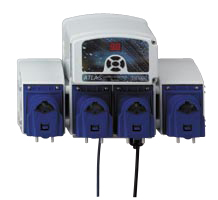
We offer Atlas dispensers for laundry systems. The Atlas dispensing system is a modular peristaltic pump system that allows up to six pumps and a flush system or seven pumps without a flush system. The pumps are also housed in a high impact ABS splash-resistant enclosure and are mounted to the wall with an integrated stainless steel mounting bracket system. Our dispensers are an essential piece of industrial laundry systems.

Image result for atlas laundry pumpPump features include:

  • Three modes of operation (formula select, relay, and sequence)
  • 30-formula capability (unused formulas may be disabled)
  • Lockout
  • Load count
  • EDSM (enhanced digital select module)
  • Auto-calibrate
  • Bleach defeat function
  • Program storage
  • Password protection
  • Quick change pump design

To see some of our service technicians and learn about their experience and history, visit our team page. If you have any questions, please contact us for more information.


When to Use QACs

February 12th, 2020 by Ima Admin

Quaternary Ammonium Compounds (QACs or quats) are often used to kill microorganisms in food production, food service, health care, and other environments. Their flexibility of application, residual efficacy, and mild odor make them an attractive choice when picking a disinfectant. Recently, subinhibitory levels of QACs have been shown to lead to microorganisms that are resistant to this biocide called superbugs (see the article from August here).

DeVere offers a wide range of cleaners, sanitizers, and disinfectants. Some of these contain QACs. This post will help clear up any confusion regarding when and when not to use them.

When to use QACs

Improper use of QACs can lead to superbugs. Proper use can make them one of the most efficient tools available in our war against pathogens. Generally, QACs can be used to disinfect flat, hard surfaces where the product will not end up in a drain or on the floor. For example, they work well when sanitizing desks, tables, food processing surfaces, and windowsills (primarily for mold inhibition).

QACs also work well as sanitizers in the 3rd sink in bars and other foodservice areas with 3-sink setups. 3rd sink applications will eventually send the QAC to the drain undiluted. The undiluted part is the key. The idea here is that they do not last long in a subinhibitory concentration before other materials in the sewer or septic system deactivate them.

One Step Quaternary Cleaner and Disinfectant and QDII Sanitizer are two of DeVere’s QAC-based products and are often used when sanitizing and disinfecting flat surfaces. See their product pages for more details on the product and when to use them.

QACs are generally not great cleaners on their own, but many of our products that contain them are great cleaners. Products like Restroom Cleaner and Deodorizer contain QACs to help deodorize and make surfaces safe for human use.

When not to use QACs

If you plan on sanitizing or disinfecting entryways, floors, or drains, we do not recommend QACs. This includes quat rings, door foamers, powdered quat, and any other application where the product will be slowly diluted while exposed to pathogens. Much like they can evolve immunity to antibiotics, bacteria and viruses can evolve resistances to QACs. The resistances are formed when there is not enough QAC present to kill pathogens and enough to react. See this article for references and more information.

Security Floor Treatment and Security Floor Sanitizer are DeVere’s top alternatives to QACs and use oxidizers as primary active ingredients. Pathogens cannot build resistance to oxidizers. This means that these products are perfect for use on floors and around drains. To learn more about each product, you can visit their product pages, and see this post to learn about the differences between each product.


Concentrates vs. Ready to Use

November 13th, 2019 by Ima Admin

DeVere offers a wide range of products in our attempt to please all customers. One subcategory that each of our products falls into is concentrates vs. ready to use cleaners. Most ready to use cleaners have a concentrated version that makes the same product after dilution. Each cleaner has its advantages and we are here to help make it easier for you to decide which is best for your situation. Below is a list of differences between concentrates and ready to use cleaners.

Price:

Generally, concentrates are more expensive than ready to use cleaners per gallon. This is because the concentrate has more cleaning chemicals in it, and ready to use cleaners are already diluted to the optimal use concentration. For products like Window Cleaner and Window Cleaner Concentrate, the concentrate will be more expensive per bottle and less expensive per use. Packaging also increases the price. The more packaging per use, the more the cost per use. Smaller packages cost more per unit volume than larger packages. Aerosols are generally the most expensive and most convenient form of cleaning product. Concentrated chemicals are the most economical form in terms of cost-per-use.

Usage:

As stated before, concentrates have less water than ready to use products. In this case, more cleaning chemical is not always better. DeVere products require water to work properly. The cleaning chemicals will dissolve/remove the soils and the water will act as the solvent to carry the soils away.

Ease of Use:

Most of the time, ready to use cleaners and aerosols are easier to use than concentrates. It takes less time to clean with ready to use cleaners because there is no need to dilute. Ready to use cleaners also typically come with sprayers or flip top caps to make cleaning even easier.

Environmental Concerns:

In general, the more concentrated the product, the less packaging (usually plastic) and energy (manufacturing and freight) are needed to clean. DeVere’s line of concentrated products is designed to be as environmentally helpful as possible. These products clean and sanitize surfaces to remove harmful soils and pathogens while minimizing the environmental impact of packaging and shipping.

Product Sizes:

Concentrates typically come in 1-gallon jugs, 4 x 1-gallon cases, 5-gallon pails, 55-gallon drums, or some combination thereof. Ready to use cleaners typically come in quarts and cases of multiple quart bottles with convenient applicators. Occasionally, ready to use cleaners will come in gallons, but generally nothing bigger. Aerosols come in cans (generally 18-19 oz) and cases of multiple cans. If you need an easily portable bottle for the cleaner, then a ready to use cleaner may be the best for you. If you need a lot of the cleaner for commercial or industrial applications, then a concentrate may be the best. DeVere supplies reusable bottles and sprayers for most concentrated cleaners.

Example: Citrus, Citrus Ready to Use, Citrus Plus Foaming Cleaner

  • One gallon of Citrus will make 32 quarts of Citrus Ready to Use.
  • You will get the most value out of Citrus because you are getting more cleaner.
  • Citrus Ready to Use and Citrus Plus will be the easiest to use because you do not need to take the extra step to dilute the product.
  • Citrus is available in gallons and larger sizes, Citrus Ready to Use is available in quarts, and Citrus Plus is available in 19 oz cans.

If you have any questions about concentrates vs. ready to use or any of our products, please contact us.